
Navigating the Chasebet login process and mastering its application ecosystem requires a technical understanding of its architecture, security protocols, and edge-case scenarios. This manual serves as an exhaustive whitepaper for users and administrators, detailing not just the ‘how’ but the ‘why’ behind every function, from authentication mechanics to complex wagering calculations and system-level troubleshooting. We will deconstruct the platform’s operational framework to ensure robust and efficient usage.
Before You Start: System Readiness Checklist
Prior to initiating the Chasebet login sequence, verify the following prerequisites to prevent authentication failures and performance degradation. This checklist is critical for protocol compliance and optimal user experience.
- Geolocation Compliance: Confirm your physical location is within a jurisdiction where Chasebet operates legally. VPN usage is strictly prohibited and will trigger security locks.
- Device Integrity: Ensure your device OS (iOS, Android, Windows) is updated to a supported version. Outdated systems may cause app crashes or SSL handshake failures.
- Credential Hygiene: Have your registered email and a strong, unique password ready. Passwords should be a minimum of 12 characters with mixed cases, numbers, and symbols.
- Network Security: Connect via a private, stable network. Public Wi-Fi often employs port blocking or deep packet inspection that can interfere with the secure Chasebet login socket.
- Browser/App State: Clear your browser cache and cookies if using the web version, or ensure the Chasebet app is updated to the latest build from the official source.
Registration: Account Provisioning & KYC Initialization
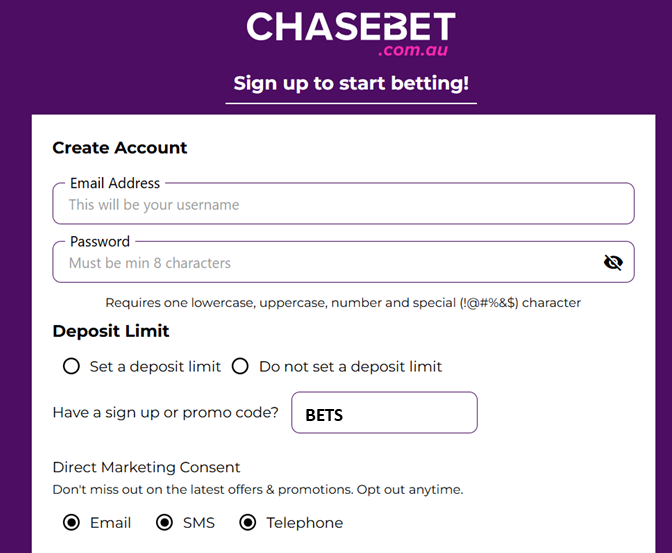
Account creation is the provisioning phase where your digital identity is established within Chasebet’s database. This process initiates the Know Your Customer (KYC) pipeline.
- Access Point: Navigate to the Chasebet homepage and select the ‘Registration’ modal.
- Data Layer Input: Populate the form with legally accurate personal data (Full name, DOB, address). Discrepancies here will cause irreversible KYC rejection later.
- Credential Generation: Define your login email and password. This creates your primary authentication key pair.
- Telephone Verification: A one-time password (OTP) is sent via SMS to bind your phone number to the account, adding a 2-factor authentication (2FA) channel.
- KYC Trigger: Upon first deposit or withdrawal attempt, the system will prompt for document upload (ID, proof of address). This is an asynchronous process; account functionality is limited until verification completes (typically 1-72 hours).
Mobile Application: Architecture & Deployment
The Chasebet app is a native-wrapper hybrid application, offering near-native performance with streamlined update cycles. Its architecture prioritizes secure session management.
- Acquisition: Download exclusively from the official Chasebet website. Third-party app stores host deprecated or malicious builds.
- Installation Permissions: The app requires permissions for network access and storage (for caching game data). It does not require intrusive permissions like contacts or SMS read.
- Session Persistence: Upon successful Chasebet login, the app maintains a secure session token in encrypted local storage. Biometric login (Touch ID, Face ID) can be enabled post-initial login for faster re-authentication.
- Push Notification System: Opt-in to receive real-time alerts for bet settlements, deposit confirmations, and bonus expiration warnings. Configure this in-app under ‘Notifications’.
| System Component | Specification | Operational Limit / Note |
|---|---|---|
| Authentication Protocol | OAuth 2.0 / JWT Tokens | Session timeout: 15 minutes inactivity |
| Supported Client OS | Android 8.0+, iOS 13+, Modern Browsers | WebSocket required for live betting |
| Max Concurrent Sessions | 2 Devices | Third login forces oldest session logout |
| Financial API Limits | Min Deposit: €10, Min Withdrawal: €20 | Max Withdrawal: €50,000/month (varies by VIP) |
| Data Transmission | TLS 1.3 Encryption | 256-bit AES-GCM cipher suite |
| KYC Document Format | JPEG, PNG, PDF (Max 5MB/file) | Verification SLA: 24-72 hours |
Bonus Mathematics & Wagering Cost Analysis
Understanding the financial engineering behind bonuses is critical. A 100% match bonus up to €200 with a 40x wagering requirement (WR) is a common offer. Let’s model the cost.
Scenario: Deposit €100, receive €100 bonus. Total balance: €200. WR = (Deposit + Bonus) * 40 = €200 * 40 = €8,000 must be wagered before withdrawal.
Expected Loss Calculation: Assuming a game with a 96% RTP (Return to Player), the house edge is 4%. The expected loss on turning over €8,000 is €8,000 * 0.04 = €320.
Net Value Analysis: Your starting capital was €100 deposit. An expected loss of €320 means, statistically, you will lose not only your bonus but also your entire deposit and more. This model shows that high WR bonuses are only viable on low-edge games (e.g., Blackjack with 0.5% edge: €8,000 * 0.005 = €40 expected loss), making the bonus potentially profitable.
Strategy: Always calculate the Required Turnover and multiply by the game’s house edge to find the Expected Bonus Cost. Compare this to the bonus nominal value.
Banking Layer: Deposit & Withdrawal Protocols
The financial engine uses distinct protocols for inbound (deposit) and outbound (withdrawal) transactions, with different security gates.
- Deposit (Credit Flow): Near-instant processing. Methods include Cards, E-Wallets (Skrill, Neteller), and Bank Transfer. Deposits trigger bonus eligibility checks. Always use the same method for deposit and withdrawal where possible to avoid complications.
- Withdrawal (Debit Flow): A multi-stage process. (1) Request submitted. (2) Internal audit for WR completion and gameplay pattern review (anti-bonus abuse). (3) KYC document final verification. (4) Processing by finance department (24-48 hours). (5) Network transfer to your method (instant to 5 banking days). The entire pipeline can take 1-7 business days.
Security Architecture & Threat Mitigation
Chasebet employs a defense-in-depth strategy.
- Encryption: End-to-end TLS 1.3 for data in transit. Personal data is encrypted at rest using AES-256.
- Fraud Detection: Behavioral analytics monitor for atypical betting patterns, rapid currency switching, or IP hopping.
- Account Lock Triggers: Five consecutive failed Chasebet login attempts trigger a 30-minute lock. Suspected compromised accounts are frozen pending customer service investigation.
- Player Responsibility: Enable 2FA, never share session tokens, and log out from public devices. Monitor your account history for unauthorized transactions.
Advanced Troubleshooting Scenarios
This section addresses systemic failures beyond simple password resets.
Scenario A: Persistent “Invalid Credentials” Post-Correct Login.
Likely Cause: Browser cache corruption or a mismatched session token.
Resolution Path: 1) Perform a ‘hard refresh’ (Ctrl+F5). 2) Clear browser cache and cookies for the Chasebet domain specifically. 3) Attempt login in an incognito/private window. 4) If using the Chasebet app, clear app cache (Android) or offload & reinstall (iOS).
Scenario B: Successful Login But Immediate Redirect to Login Page (Loop).
Likely Cause: Geolocation check failure or incompatible browser setting.
Resolution Path: 1) Disable any ad-blocker or script-blocker extension for the site. 2) Ensure JavaScript and cookies are enabled. 3) Verify your ISP is not routing through a foreign proxy. 4) Check system time/date—incorrect time can break SSL certificates.
Scenario C: App Crashes on Launch or During Live Betting.
Likely Cause: Memory overflow, corrupted local data, or network instability.
Resolution Path: 1) Force stop the app and restart your device. 2) Check for and install any OS updates. 3) Ensure a stable Wi-Fi connection; mobile data can drop packets during live streams. 4) As a last resort, uninstall, reboot device, and reinstall the app from the official source.
Extended FAQ: Systemic Queries
Q1: I’ve forgotten my password and the reset email isn’t arriving. What are the systemic checks?
A1: First, check spam/junk folders. If not found, the issue may be: a) The registered email has a typo (contact support with ID for manual correction). b) Your email provider is blocking automated sends (temporarily whitelist @chasebet.org). c) A delay in the email queue (wait 15 minutes).
Q2: Can I change my registered email address or username?
A2: For security, the primary registered email cannot be changed via self-service. You must contact support with valid KYC documentation proving ownership of both the old and new email addresses. Usernames are typically immutable.
Q3: Why was my withdrawal reversed and funds returned to my betting balance?
A3: This occurs when a withdrawal request is made before meeting the Wagering Requirement (WR) in full, or if a bonus was active but not yet cycled through the WR audit. The system automatically reverses the transaction and returns funds to the playable balance to complete the requirement.
Q4: What does “Account Under Verification” status mean, and how long does it last?
A4: This is a manual review state triggered by: large withdrawal request, suspicious activity, or random audit. All gaming and withdrawal functions are suspended. Duration is typically 12-72 hours. You will be contacted by the compliance team if additional documents are needed.
Q5: How is the Geo-location check performed, and why does it fail on my home network?
A5: The check uses a combination of your device’s IP address (via WHOIS lookup) and sometimes GPS data (on mobile). Failure at home can be due to: a) Using a VPN or Proxy (even if disabled, some router firmware includes one). b) Your ISP using dynamic IPs from a pool in a different region. c) Mobile data switching between towers.
Q6: Are there API access points for automated betting or data feeds?
A6: No. Chasebet does not provide a public API for betting operations. Any use of bots, scripts, or automated agents to interact with the platform is a direct violation of the Terms of Service and will result in permanent account closure and confiscation of funds.
Q7: What is the logic behind “Bonus Bet” settlement and conversion to cash?
A7: A Bonus Bet is a non-cash credit used to place a bet. If the bet wins, the profit portion (total return minus the stake value of the bonus bet) is credited as real, withdrawable cash. The original bonus bet stake is not returned. Example: A €10 Bonus Bet at 2.0 odds wins €20. Your cash balance increases by €10 (the profit).
Q8: My account is closed. Can I open a new one with different details?
A8: No. Attempting to open a new account after a closure (especially for Terms breaches) constitutes fraud. Their system checks multiple data points (name, DOB, IP, device ID, bank details). Detection will lead to immediate closure and possible blacklisting from all associated brands.
Conclusion: Mastering the Chasebet ecosystem requires treating it as a complex technical system rather than a simple website. From the initial Chasebet login cryptographic handshake to the nuanced financial engineering of bonuses and the multi-layered security protocols, each interaction is governed by defined rules and processes. By understanding the architecture detailed in this manual—the app’s session management, the KYC pipeline, the mathematical cost of bonuses, and the resolution paths for systemic failures—you transform from a basic user to an informed operator, capable of navigating the platform with maximum efficiency and minimal risk. Always prioritize security hygiene and read the specific Terms of Service associated with your account, as they form the binding contract for all interactions.